






1.Introduction
High-solids hydroxy acrylic resins are an important binder technology for modern solventborne industrial coatings, especially where low VOC, excellent appearance, and high durability are required. When crosslinked with aliphatic polyisocyanates, they form two-component polyurethane coatings with very good gloss retention, hardness, chemical resistance, and outdoor durability.
While conventional industrial coating systems are typically based on two-layer structures (primer + topcoat) (Figure 1) to ensure sufficient corrosion protection and decorative performance, there is increasing interest in one-layer DTM (direct-to-metal) systems, which offer advantages in terms of reduced application steps, lower processing costs, and improved sustainability. However, their performance is strongly dependent also on proper surface preparation, as substrate cleanliness, roughness, and chemical condition directly determine adhesion, corrosion resistance, and long-term durability. High-solids hydroxy acrylic resins are used in many demanding coating segments, including: general industrial coatings, ACE and machinery coatings, transportation coatings, protective topcoats, metal furniture, car refinish, industrial wood coatings, plastic coatings, clearcoats and pigmented topcoats for general industry.
This article presents we introduce HS acrylic and polyester resins in DTM formulation the main design principles, performance benefits, and application areas of high-solids hydroxy acrylic resins, with a focus on their role in sustainable industrial coating systems tested on different metal substrate preparation conditions.
2. Chemistry and resin design
Hydroxy acrylic resins are acrylic copolymers containing hydroxyl-functional monomers. These hydroxyl groups react with isocyanate groups from the hardener to form urethane linkages (Figure 2.). The reaction creates a crosslinked polyurethane network, which gives the coating its final hardness, chemical resistance, weatherability and mechanical strength.
In high-solids systems, resin design is critical. The binder must have sufficiently low viscosity at high solids content, but it must still provide enough molecular structure and functionality to form a durable film.
Lower molecular weight generally helps to reduce resin viscosity and enables higher solid content in the formulation. However, if the molecular weight is too low, the resulting coating may exhibit weaker early film strength, slower hardness development, and reduced mechanical resistance. Therefore, the resin backbone must be carefully balanced to achieve an optimal compromise between processability and final performance.
In this study, Domacryl 5485 (75% solid content, solubilized in butyl acetate) was selected as the primary high-solids acrylic polyol. In addition, two different co-binders were incorporated into representative high-solids DTM formulations to evaluate their influence on coating performance (Table 1).
Table 1. High-solids hydroxy acrylic resins and co-binders used in HS DTM coating materials.
The hydroxyl value is another essential parameter. Higher hydroxyl functionality generally improves crosslink density, hardness and chemical resistance, but it also increases isocyanate demand and can influence flexibility, pot life and cost. The correct hydroxyl value depends on the required final coating properties and the target application.
3. Benefits of high-solids hydroxy acrylic resins
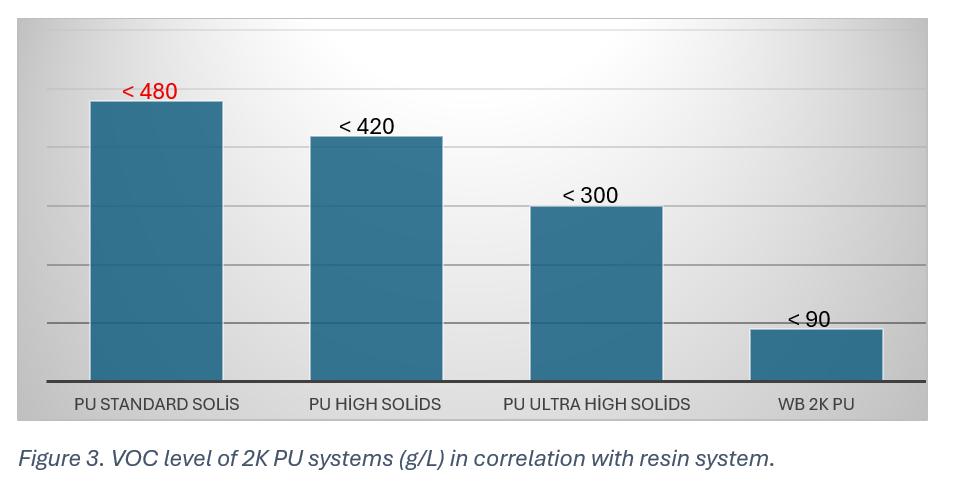
High-solids hydroxy acrylic resins are mainly used to formulate coatings with reduced solvent content. This supports lower VOC emissions and helps coating producers meet increasingly strict environmental and regulatory requirements. High-solids, ultra-high solid and waterborne resin technologies are all recognized as important routes for reducing solvent emissions while maintaining coating performance.
4. Technical Specifications and Performance Values
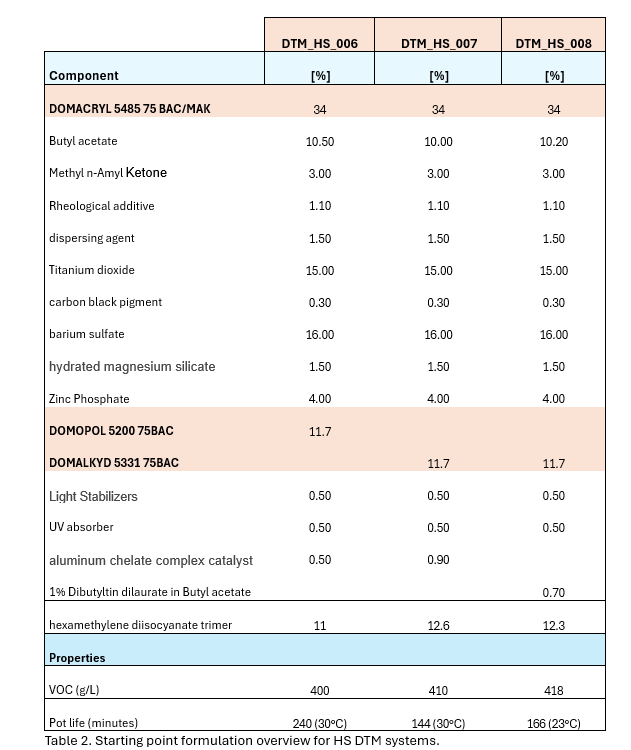
Successful formulation of high-solids 2K acrylic polyurethane coatings requires attention to the full coating system, not only to the binder. The most important formulation parameter is the NCO/OH ratio. A balanced ratio is required to achieve optimum crosslinking. We have tested HS acrylic resin in three different DTM formulations (Table 2).
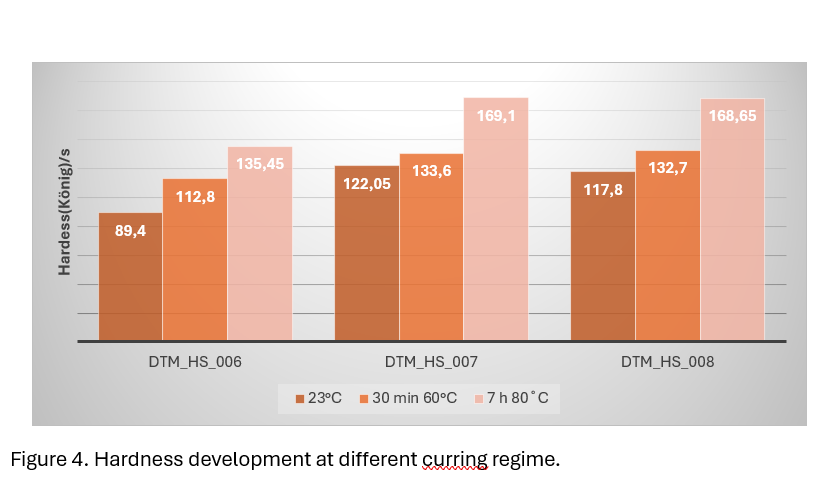
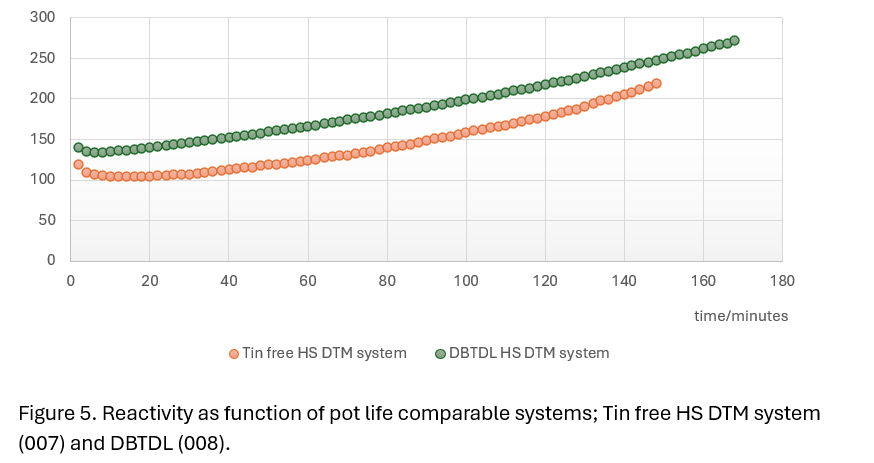
The hardness development demonstrates that both co-binder type (polyester vs. alkyd) and catalyst efficiency strongly control curing kinetics. Alkyd-based systems (DTM_HS_007 and 008 - DOMALKYD 5331 75BAC) enable faster network formation and higher hardness compared to the polyester-based system (DTM_HS_006 - Domopol 5200), while both catalyst systems ultimately reach a similar final crosslink density at elevated temperatures. The pot life results (time in which the viscosity of the coating doubles) confirm that increasing catalytic activity (especially in alkyd-based systems) significantly accelerates curing but reduces processability, while polyester-based systems (006) with lower catalyst loading ensure a longer and more stable application window. Additional also we can see that tin free system pot life at 30°C and DBTDL at 23°C shows comparable curing kinetics (Figure 5).
This trend is further supported by the drying behaviour, where DTM_HS_006, polyester type, Domopol 5200, shows significantly slower drying due to the polyester co-binder, while DTM_HS_007 and 008, based on Domalkyd 5331, exhibit markedly faster drying rates, confirming enhanced curing kinetics in alkyd-modified systems.
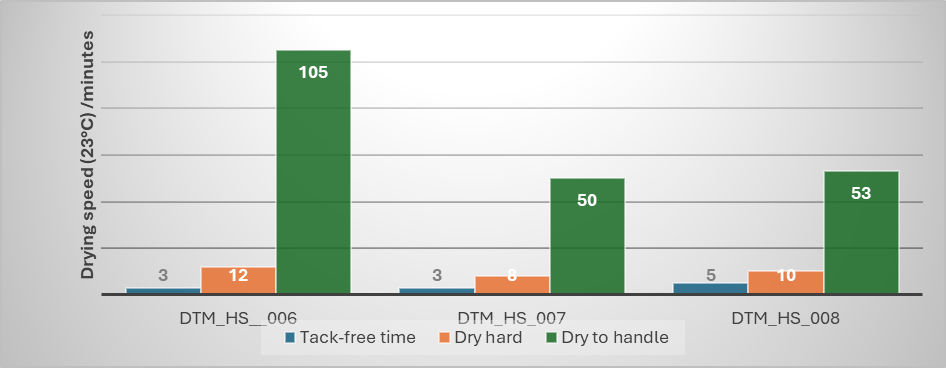
Figure 6. Drying speed results 23°C.
5. Application and corrosion tests on different metal substrates
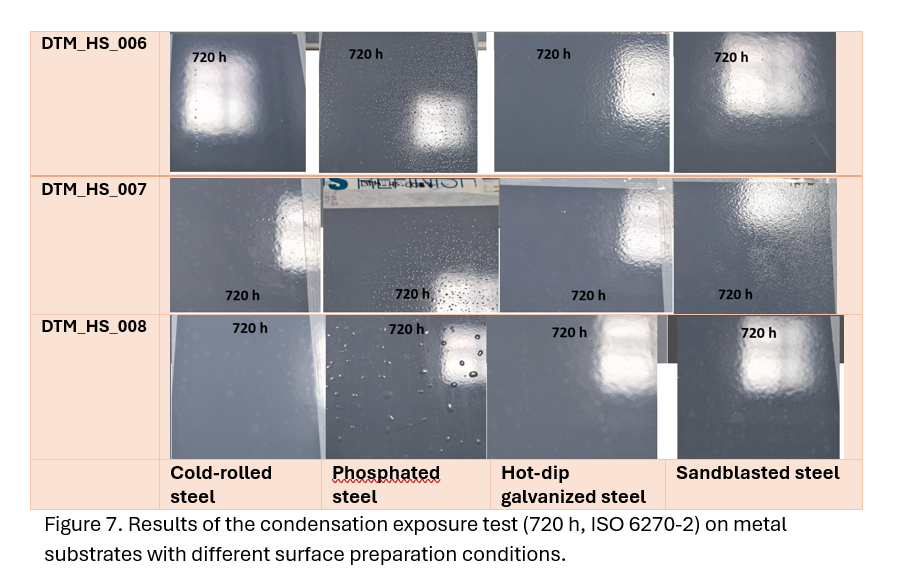
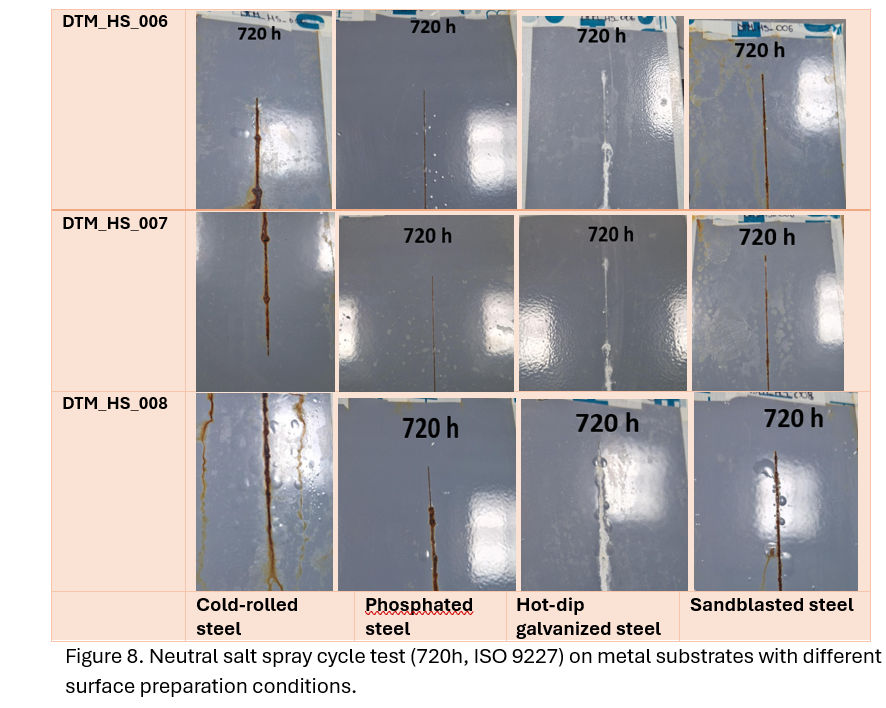
Corrosion resistance and adhesion were further evaluated on different substrates for 006 formulation system, including cold rolled steel, phosphated steel, hot-dip galvanized steel (HDG), and sandblasted steel. Adhesion performance was assessed after exposure in a humidity chamber according to ISO 6270-2 and neutral salt spray cycle test ISO 9227 at exposure period of 720 hours. The dry film thickness for panels were 140 ± 36 µm.
Clearly deviation at different surfaces is seen - phosphated steel surfaces consistently showed the poorest performance across all formulations in condensation exposure (Figure 7).
In the neutral salt spray (NSS) test (ISO 9227), formulation 008 exhibited lower corrosion and blistering compared to formulations 006 and 007; however, it showed greater delamination at the scribe, indicating differences in adhesion performance or interfacial stress development (Figure 8).
5. Conclusion
High-solids hydroxy acrylic resins represent an effective solution for developing low-VOC, high-performance 2K polyurethane coatings. The study confirms that both co-binder type and catalyst selection strongly influence curing kinetics, hardness development, pot life, and drying behavior. Alkyd-based systems exhibited faster curing and improved hardness, while polyester-based systems provided longer processing windows.
Corrosion and adhesion performance were found to be highly dependent on substrate preparation. While formulation 008 showed improved corrosion and blistering resistance, increased delamination at the scribe indicates differences in interfacial behavior and adhesion strength. Overall, the results demonstrate that achieving robust DTM performance requires a balanced optimization of resin design, formulation parameters, and substrate preparation.