


Renkler, yalnızca estetik bir unsur olmanın ötesinde, kullanıcı tercihlerini doğrudan etkileyen ve ürünlerin fonksiyonel performansına katkı sağlayan kritik bileşenlerdir. Boya ve kaplama sistemlerinde renk; görsel çekiciliğin yanı sıra, uygulandığı yüzeyi çevresel etkilere karşı koruma, dayanıklılık ve uzun ömür gibi özelliklerle de ilişkilidir. Bu nedenle, renk oluşumunda temel rol oynayan pigmentlerin formülasyon içerisinde homojen ve kararlı bir şekilde dağıtılması büyük önem taşımaktadır.
Pigmentlerin etkin performans gösterebilmesi, yalnızca kimyasal yapıları ile değil, aynı zamanda sistem içerisinde nasıl disperse edildikleri ile doğrudan ilişkilidir. Yetersiz dispersiyon; düşük renk gücü, flokülasyon, yüksek viskozite ve zamanla stabilite kaybı gibi istenmeyen sonuçlara yol açmaktadır. Bu noktada dispersiyon ajanları, pigment partiküllerinin ıslatılması, öğütülmesi ve stabilizasyonu süreçlerinde kritik rol oynayan katkı maddeleri olarak öne çıkmaktadır.
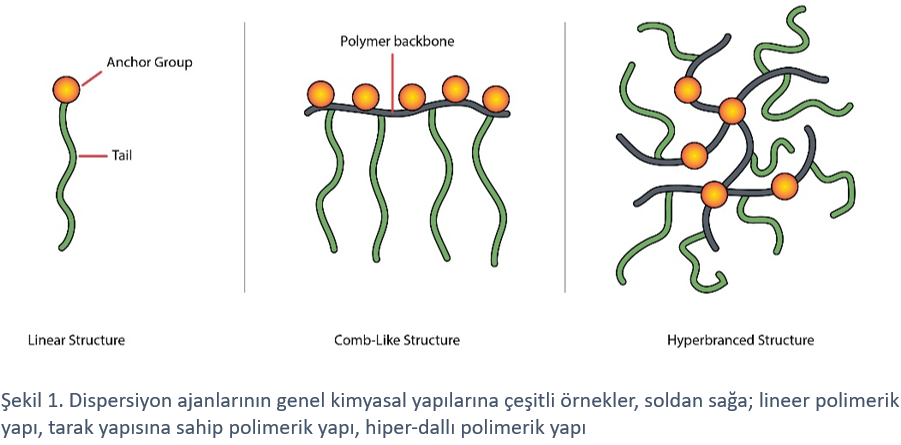
Boya teknolojilerinin gelişmesiyle birlikte, geleneksel düşük molekül ağırlıklı dispersiyon ajanlarının performans limitleri daha belirgin hale gelmiştir. Özellikle yüksek pigment yüklemelerinde stabilitenin sağlanamaması, viskozite kontrolündeki zorluklar ve renk gücündeki kayıplar, yeni nesil dispersiyon ajanlarının geliştirilmesini zorunlu kılmıştır. Günümüzde bu ihtiyaçlara cevap verebilmek amacıyla, yüksek molekül ağırlıklı ve fonksiyonel olarak modifiye edilmiş polimerik dispersiyon ajanları yaygın olarak kullanılmaktadır. Şekil 1’de dispersiyon ajanlarının kimyasal yapıları en genel hali ile gösterilmiştir.
Dispersiyon ajanlarının etkinliği temel olarak üç ana mekanizma ile açıklanmaktadır: ıslatma (wetting), ayrıştırma (deagglomeration) ve stabilizasyon. Stabilizasyon ise çoğunlukla elektrostatik, sterik veya elektrosterik mekanizmalar ile sağlanır [1]. Özellikle karbon siyahı gibi yüksek yüzey alanına sahip ve güçlü aglomerasyon eğilimi gösteren pigmentlerde, sterik stabilizasyon sağlayan polimerik yapılar kritik avantaj sunmaktadır [2].
Bu kapsamda, Denge Kimya bünyesinde geliştirilen hiper-dallı (hyperbranched) yapıya sahip Densurf RD-DA 4117 dispersiyon ajanı, özellikle üniversal ve PVC reçine sistemlerinde karbon siyahı dispersiyonu için optimize edilmiştir. Ürün, yüksek yüzey alanlı pigmentlerin etkin şekilde ıslatılması ve uzun süreli stabilizasyonunun sağlanması ihtiyacına cevap vermek üzere tasarlanmıştır. Aynı zamanda organik pigmentlerle de geniş uyumluluk göstermesi hedeflenmiştir.
Densurf RD-DA 4117’nin moleküler tasarımında, pigment yüzeyine güçlü adsorpsiyon sağlayan çoklu ankor (anchoring) grupları kullanılmıştır. Bu sayede pigment yüzeyine sıkı bağlanma sağlanırken, hiper-dallı polimerik yapı sayesinde partiküller arasında etkin bir sterik engel oluşturularak flokülasyonun önüne geçilmektedir. Ayrıca, molekül yapısında yer alan uyumlaştırıcı segmentler sayesinde farklı reçine sistemleri ile yüksek uyumluluk elde edilmektedir.
Geliştirilen dispersiyon ajanı aşağıdaki performans avantajlarını sunmaktadır:
- Hızlı ıslatma ve dispersiyon: Karbon siyahı gibi zor disperse olan pigmentlerde kısa sürede etkin dağılım sağlar.
- Yüksek renk gücü (color strength): Pigment partiküllerinin optimum boyuta kadar ayrıştırılması ile maksimum renk verimi elde edilir.
- Düşük viskozite: Yüksek pigment yüklemelerinde dahi sistem viskozitesini düşürerek işlenebilirliği artırır.
- Uzun süreli stabilite: Sterik stabilizasyon mekanizması sayesinde yeniden aglomerasyonu engeller.
- Geniş sistem uyumluluğu: Solvent bazlı ve solventsiz sistemlerde etkin performans gösterir.
- %100 aktif içerik: Solvent içermeyen yapısı ile formülasyona ilave VOC yükü getirmez ve sürdürülebilirlik açısından avantaj sağlar.
Densurf RD-DA 4117 ve seçili rakip dispersiyon ajanlarının, üniversal taşıyıcı sistemlerde karbon siyahı pigmenti üzerindeki performansları karşılaştırmalı olarak incelenmiştir. Çalışmada kullanılan üniversal sistem formülasyonu Tablo 1’de sunulmuş olup, ilgili sistemde hazırlanan pigment pastalarının reolojik ve dispersiyon karakteristikleri Tablo 2’de verilmiştir. Ayrıca, hazırlanan boyaların metal substrat üzerine uygulanması sonrası elde edilen film yüzey morfolojileri Tablo 3’te karşılaştırmalı olarak değerlendirilmiştir.
Elde edilen sonuçlar, Densurf RD-DA 4117’nin özellikle pigment ıslatma kabiliyeti ve dispersiyon stabilitesi açısından referans ürünlere kıyasla belirgin bir performans avantajı sunduğunu göstermektedir.
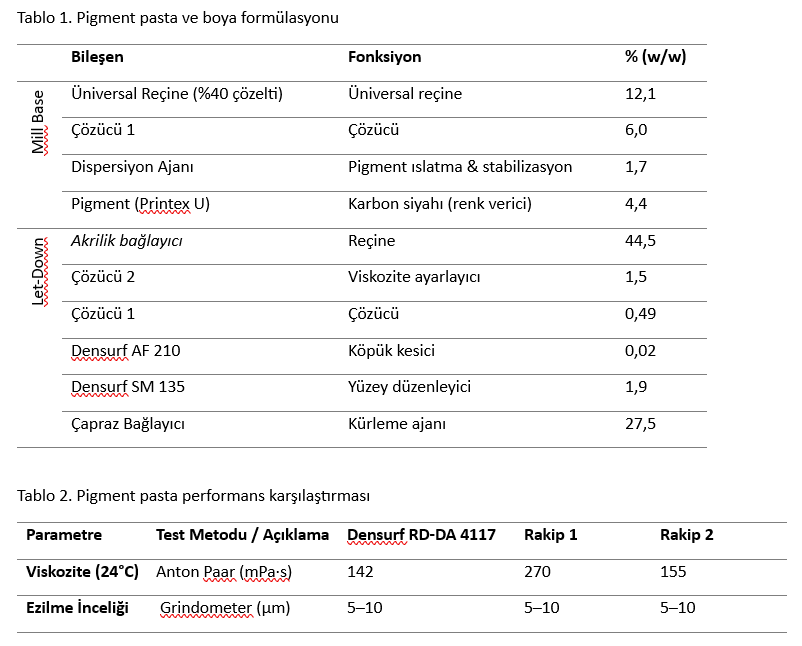
Tüm sistemlerde benzer dispersiyon inceliği değerleri elde edilmesine rağmen, viskozite sonuçları dispersiyon ajanlarının sistem içindeki etkileşimlerini açıkça ortaya koymaktadır. Densurf RD-DA 4117 ile formüle edilen sistem, belirgin şekilde daha düşük viskozite sergileyerek daha iyi pigment ıslatma ve partikül ayrışması sağladığını göstermektedir. Buna karşılık, Rakip 1 yüksek viskozite değeri ile yetersiz dispersiyon ve artan partikül–partikül etkileşimine işaret etmektedir.
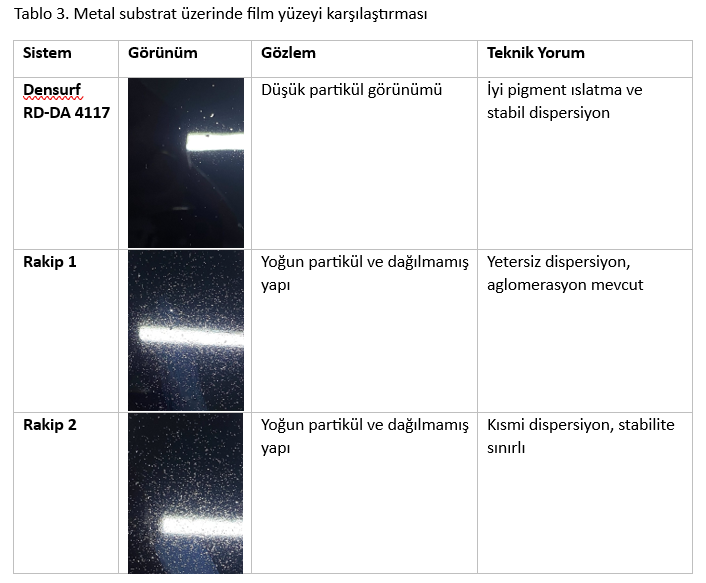
Metal substrat üzerinde elde edilen film yüzeyleri incelendiğinde, dispersiyon ajanının performansının yalnızca reolojik özelliklerle sınırlı olmadığı, aynı zamanda nihai kaplama kalitesi üzerinde doğrudan etkili olduğu görülmektedir. Densurf RD-DA 4117 kullanılan sistemde, düşük partikül görünümü ve yüksek yüzey homojenliği dikkat çekmektedir. Bu durum, pigment yüzeyine etkin adsorpsiyon ve partiküller arası itici kuvvetlerin yeterli seviyede sağlandığını göstermektedir.
Rakip ürünlerde ise özellikle Rakip 1’de belirgin aglomerasyon ve yüzey kusurları gözlemlenmiş olup, bu durum yetersiz dispersiyon stabilitesi ile ilişkilendirilmektedir. Rakip 2’de ise kısmi iyileşme gözlenmekle birlikte, sistemin tam anlamıyla stabilize edilemediği anlaşılmaktadır.
Sonuç olarak, Densurf RD-DA 4117, özellikle yüksek yüzey alanına sahip karbon siyahı pigmentlerin dispersiyonunda üstün performans sergileyerek hem düşük viskozite hem de yüksek film homojenliği sağlamaktadır. Gelişmiş moleküler tasarımı sayesinde pigment yüzeyine etkin adsorpsiyon sağlayan ürün, flokülasyon eğilimini minimize ederek sistem stabilitesini artırmaktadır.
Bu özellikleriyle Densurf RD-DA 4117, modern boya ve kaplama sistemlerinde hem proses verimliliğini hem de nihai ürün kalitesini optimize eden yüksek performanslı bir dispersiyon ajanı olarak öne çıkmaktadır.
EN
Role of Dispersing Agents and Polymeric Solutions in Modern Coating Systems
Color is not only an aesthetic element in coatings, but also a critical parameter that directly influences user preferences and contributes to product performance. In paint and coating systems, color is associated not only with visual appeal but also with functional properties such as protection against environmental factors, durability, and long service life. Therefore, ensuring a homogeneous and stable distribution of pigments within the formulation is of great importance.
The effective performance of pigments depends not only on their chemical structure but also on how well they are dispersed within the system. Poor dispersion leads to undesirable outcomes such as reduced color strength, flocculation, increased viscosity, and long-term stability issues. At this point, dispersing agents play a critical role as functional additives responsible for the wetting, deagglomeration, and stabilization of pigment particles.
With the advancement of coating technologies, the performance limitations of conventional low molecular weight dispersing agents have become more evident. Particularly under high pigment loading conditions, challenges such as insufficient stability, difficulties in viscosity control, and loss of color strength have necessitated the development of next-generation dispersing agents. To address these needs, high molecular weight and functionally modified polymeric dispersing agents are increasingly being utilized. Figure 1 illustrates representative examples of the general chemical structures of dispersing agents.
Figure 1. Representative examples of the general chemical structures of dispersing agents, from left to right: linear polymeric structure, comb-shaped polymeric structure, and hyperbranched polymeric structure.
The efficiency of dispersing agents is generally explained through three main mechanisms: wetting, deagglomeration, and stabilization. Stabilization is typically achieved through electrostatic, steric, or electrosteric mechanisms [1]. In pigments such as carbon black, which have high surface area and a strong tendency to agglomerate, polymeric structures providing steric stabilization offer significant advantages[2].
In this context, Densurf RD-DA 4117, a hyperbranched polymeric dispersing agent developed by Denge Kimya, has been specifically optimized for carbon black dispersions in universal carrier systems and PVC-based resin systems. The product has been designed to ensure effective wetting of high surface area pigments and to provide long-term dispersion stability. In addition, it is intended to exhibit broad compatibility with organic pigments.
The molecular design of Densurf RD-DA 4117 incorporates multiple anchoring groups that provide strong adsorption onto the pigment surface. This ensures firm attachment to the pigment, while the hyperbranched polymeric structure creates an effective steric barrier between particles, thereby preventing flocculation. Furthermore, the presence of compatibility-enhancing segments in the molecular structure enables excellent compatibility with various resin systems.
The developed dispersing agent offers the following performance advantages:
- Fast wetting and dispersion: Provides effective distribution in a short time, even for difficult-to-disperse pigments such as carbon black.
- High color strength: Maximum color efficiency is achieved through optimal deagglomeration of pigment particles.
- Low viscosity: Improves processability by reducing system viscosity even at high pigment loadings.
- Long-term stability: Prevents re-agglomeration through steric stabilization mechanisms.
- Broad system compatibility: Demonstrates effective performance in both solvent-based and solvent-free systems.
- 100% active content: Solvent-free structure does not contribute to VOC and provides sustainability advantages.
The performance of Densurf RD-DA 4117 and selected competitor dispersing agents was comparatively evaluated in universal carrier systems using carbon black pigment. The general formulation of the universal system is presented in Table 1. The properties of the pigment pastes prepared with different dispersing agents are shown in Table 2, while the surface images of the coatings obtained after application on metal substrates are provided in Table 3.
When compared with existing competitor products in the universal system, Densurf RD-DA 4117 stands out particularly in terms of pigment wetting and dispersion efficiency.
Despite achieving similar fineness of grind values across all systems, viscosity results clearly reveal the interactions of dispersing agents within the system. The formulation containing Densurf RD-DA 4117 exhibits significantly lower viscosity, indicating more efficient pigment wetting and particle separation. In contrast, Competitor 1, with its higher viscosity, suggests insufficient dispersion and increased particle–particle interactions.
Table 3. Film surface evaluation (Metal substrate)
Examination of the film surfaces obtained on metal substrates shows that the performance of dispersing agents is not limited to rheological properties, but also directly influences the final coating quality. The system containing Densurf RD-DA 4117 demonstrates low particle visibility and high surface homogeneity. This indicates effective adsorption onto the pigment surface and sufficient interparticle repulsive forces.
In competitor systems, particularly with Competitor 1, significant agglomeration and surface defects are observed, which can be attributed to insufficient dispersion stability. Although partial improvement is observed with Competitor 2, the system still lacks complete stabilization.
As a result, Densurf RD-DA 4117 demonstrates superior performance in the dispersion of high surface area carbon black pigments, providing both low viscosity and high film homogeneity. Thanks to its advanced molecular design, it ensures effective adsorption onto pigment surfaces and minimizes flocculation tendencies, thereby enhancing system stability.
With these properties, Densurf RD-DA 4117 emerges as a high-performance dispersing agent that optimizes both processing efficiency and final product quality in modern paint and coating systems.
Kaynak
[1] Lim, B.L., & Ang, D.T.C. (2025). Toward a universal polymeric dispersant for diverse pigment systems in surface coatings via azole anchoring modification. Polymer Engineering & Science, 65(7), 3364–3376. https://doi.org/10.1002/pen.27219
[2] Lee, J., Bae, J., Kim, W., & Lee, S. (2022). A study on aqueous dispersing of carbon black nanoparticles surface-coated with styrene maleic acid (SMA) copolymer. Polymers, 14(24), 5455. https://doi.org/10.3390/polym14245455