


Özet
Küresel kaplama pazarında, çevresel regülasyonların sıkılaşması ve tüketici bilincinin artmasıyla birlikte, yüksek performanslı ve insan sağlığına duyarlı yüzey teknolojilerine olan talep ivme kazanmaktadır (Cousins et al., 2020). Kanat Boya Therna Ar-Ge tarafından geliştirilen Kanasol Kaplama Serisi, inorganik polimer kimyasına dayanan gelişmiş sol-gel teknolojisi ile mutfak gereçleri sektöründe uzun ömürlü, güvenli ve sürdürülebilir bir çözüm sunmaktadır (Brinker & Scherer, 1990).
Giriş
Günümüzde endüstriyel boya ve kaplama sektörü; mekanik performans, estetik ve regülasyon uyumluluğu (REACH, FDA vb.) üçgeninde köklü bir dönüşüm yaşamaktadır (ECHA, 2023). Özellikle gıda ile temas eden yüzeylerde geleneksel floropolimer kaplamalara yönelik artan sağlık ve çevre endişeleri, sektörü yenilikçi ve güvenli alternatiflere yöneltmiştir (Wang et al., 2017).
Küresel ölçekteki teknoloji devlerinin odaklandığı "sürdürülebilir kaplama" vizyonunu yerel mühendislik yetkinliğiyle harmanlayan Kanat Boya, bu evrensel dönüşüme Kanasol Kaplama Serisi ile öncülük etmektedir. Doğanın moleküler kusursuzluğundan ilham alan Therna Markası, endüstriye çevresel ayak izi düşük, yüksek dayanımlı bir mühendislik çözümü sağlamaktadır.
Sol-Gel Prosesi ve Fonksiyonel İnorganik Ağ Yapısı
Kanasol Kaplama Serisi'nin teknolojik altyapısı, inorganik polimer kimyasının en sofistike uygulamalarından biri olan sol-gel prosesine dayanmaktadır (Sakka, 2005).
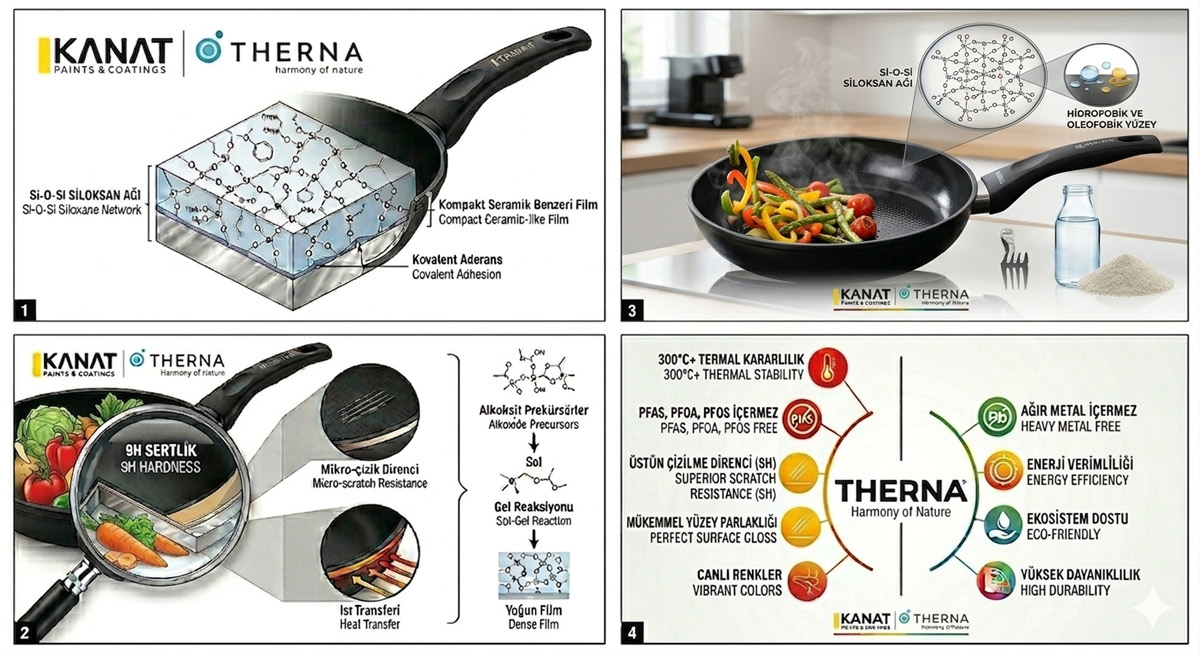
Bu teknoloji, silika bazlı öncü bileşenlerin hidroliz ve kondenzasyon reaksiyonları yoluyla üç boyutlu, çapraz bağlı, yoğun bir seramik ağ oluşturması prensibiyle çalışır (Hench & West, 1990). Geleneksel organik kaplamalardan farklı olarak bu inorganik matriks; cam ve seramiğin sahip olduğu üstün fiziksel özellikleri, yüzeylerde mükemmel bir aderans ve esneklikle birleştirir.
Optimize edilmiş bu çapraz bağlı morfoloji, yüzeyde oluşabilecek mekanik aşınmalara ve mikro-çiziklere karşı olağanüstü bir direnç sergileyerek ürünün yaşam döngüsünü maksimize eder (Klein, 1994).
Performans Karakteristikleri ve Termal Stabilite
Mutfak gereçlerinde yüzey bütünlüğünün korunması için en kritik parametre termal stabilitedir. Kanat Boya'nın geliştirdiği seramik kaplamalar, polimer zincirlerinin termal degradasyona uğramadan 300°C ve üzeri ekstrem sıcaklıklara dayanabilmesini sağlayan sağlam bir inorganik omurgaya sahiptir (Mackenzie & Bescher, 2000). Bu yüksek ısı direnci, yapısal deformasyonu engelleyerek güvenli bir pişirme deneyimi sunar. Bununla birlikte, formülasyonun sunduğu gelişmiş yüzey enerjisi optimizasyonu, üstün bir Kolay Temizlenebilirlik özelliği yaratır. Ultra pürüzsüz yüzey morfolojisi, gıda kalıntılarının yüzeye tutunmasını engellerken, temizlik kimyasallarına ve yoğun mekanik efora olan ihtiyacı minimize eder (Latthe et al., 2014). Tasarımcılar için sunulan doğadan ilham alan modern renk paleti ise bu mühendislik başarısını göz alıcı bir estetikle tamamlar.
Mevzuata Uyum ve Sürdürülebilir Üretim
Kanasol Kaplama Serisi, sektördeki en zorlu regülatif gündem maddesi olan PFAS (PFOA, PFOS ve türevi perflorlu alkil maddeler) bileşiklerini formülasyonunda sıfır tolerans ile reddeder (Galgali et al., 2019). Kurşun ve kadmiyum gibi ağır metallerden tamamen arındırılmış yapı, global sağlık standartlarına tam entegrasyon sağlar. Üretim proseslerinde sürdürülebilirlik hedefleri doğrultusunda kullanılan su bazlı sistem, geleneksel solvent bazlı alternatiflere kıyasla Uçucu Organik Bileşik (VOC) emisyonlarını çok düşük seviyelere çeker (European Commission, 2010). Bu yaklaşım, sadece ürünün karbon ayak izini düşürmekle kalmaz, endüstriyel uygulama hatlarında da ekosisteme saygılı, temiz ve güvenli bir üretim ortamı tahsis eder.
Kanat Boya Therna Ar-Ge Vizyonu
Küresel rekabet arenasında ileri malzeme biliminin gücünü sektörel tecrübesiyle birleştiren Kanat Boya, Kanasol Kaplama Serisi ile endüstriyel kaplama pazarında yeni bir standart belirlemektedir. Yenilikçi sol-gel altyapısı, tavizsiz sağlık sertifikasyonları ve çevre bilinciyle Kanat Boya; tüketiciler için katma değerli, sürdürülebilir bir teknoloji partneri olmaya devam edecektir.
...
Next-Generation Sol-Gel Technology and a Sustainable Approach in Industrial Cookware Coatings: Kanat Boya Kanasol Coating Series
Abstract
In the global coatings market, as environmental regulations tighten and consumer awareness increases, the demand for high-performance and health-conscious surface technologies is gaining momentum (Cousins et al., 2020). Developed by Kanat Boya Therna R&D Center, the Kanat Boya Kanasol Coating Series offers a long-lasting, safe, and sustainable solution in the cookware sector through advanced sol-gel technology based on inorganic polymer chemistry (Brinker & Scherer, 1990).
Introduction
Today, the industrial paint and coatings sector is undergoing a fundamental transformation within the triangle of mechanical performance, aesthetics, and regulatory compliance (e.g., REACH, FDA) (ECHA, 2023). Particularly for food-contact surfaces, growing health and environmental concerns regarding traditional fluoropolymer coatings have steered the industry toward innovative and safe alternatives (Wang et al., 2017). Blending the "sustainable coating" vision focused on by global technology giants with local engineering expertise, Kanat Boya is pioneering this universal transformation with its Kanasol Coating Series. Inspired by the molecular perfection of nature, the Therna Brand provides the industry with a low-environmentalfootprint, high-durability engineering solution.
The Sol-Gel Process and Inorganic Matrix
The technological infrastructure of the Kanasol Coating Series is based on the sol-gel process, one of the most sophisticated applications of inorganic polymer chemistry (Sakka, 2005). This technology operates on the principle of forming a three-dimensional, cross-linked, dense ceramic network through the hydrolysis and condensation reactions of silica-based precursors (Hench & West, 1990). Unlike traditional organic coatings, this inorganic matrix combines the superior physical properties of glass and ceramics with excellent adhesion and flexibility on surfaces. This optimized, cross-linked morphology exhibits extraordinary resistance to potential mechanical wear and micro-scratches on the surface, thereby maximizing the product's lifecycle (Klein, 1994).
Thermal Stability and Performance
For maintaining surface integrity in cookware, the most critical parameter is thermal stability. The ceramic coatings developed by Kanat Boya possess a robust inorganic backbone that enables polymer chains to withstand extreme temperatures of 300°C and above without undergoing thermal degradation (Mackenzie & Bescher, 2000). This high heat resistance prevents structural deformation, ensuring a safe cooking experience. Furthermore, the advanced surface energy optimization provided by the formulation creates a superior Easy-toClean property. The ultra-smooth surface morphology prevents food residues from adhering to the surface while minimizing the need for cleaning chemicals and intense mechanical effort (Latthe et al., 2014). The modern, nature-inspired color palette offered for designers complements this engineering achievement with striking aesthetics.
Regulatory Compliance and Sustainable Production
The Kanasol Coating Series rejects PFAS (PFOA, PFOS, and derivative perfluoroalkyl substances) compounds—the most challenging regulatory agenda item in the sector—with zero tolerance in its formulation (Galgali et al., 2019). Its structure, completely free of heavy metals such as lead and cadmium, ensures full integration with global health standards. The water-based system used in production processes in line with sustainability goals reduces Volatile Organic Compound (VOC) emissions to very low levels compared to traditional solvent-based alternatives (European Commission, 2010). This approach not only lowers the product's carbon footprint but also establishes an eco-friendly, clean, and safe production environment on industrial application lines.
Kanat Paint - Therna R&D Vision
Combining the power of advanced materials science with its sectoral experience in the global competitive arena, Kanat Boya sets a new standard in the industrial coatings market with its Kanasol Coating Series. With its innovative sol-gel infrastructure, uncompromising health certifications, and environmental awareness, Kanat Boya will continue to be a value-added, sustainable technology partner for consumers.
Kaynak
Kaynakça
Brinker, C. J., & Scherer, G. W. (1990). Sol-Gel Science: The Physics and Chemistry of Sol-Gel Processing. Academic Press.
Cousins, I. T., DeWitt, J. C., Glüge, J., Goldenman, G., Herzke, D., Lohmann, R., Ng, C. A., Scheringer, M., & Wang, Z. (2020). The high persistence of PFAS is sufficient for their management as a chemical class. Environmental Science: Processes & Impacts, 22(12), 2307- 2312.
European Chemicals Agency (ECHA). (2023). Annex XV Restriction Report: Per- and polyfluoroalkyl substances (PFAS). European Union.
European Commission. (2010). Directive 2010/75/EU on industrial emissions (integrated pollution prevention and control). Official Journal of the European Union.
Galgali, G. S., Varma, A. J., & Kulkarni, A. S. (2019). Eco-friendly waterborne sol-gel coatings for industrial applications. Journal of Cleaner Production, 215, 61-73.
Hench, L. L., & West, J. K. (1990). The sol-gel process. Chemical Reviews, 90(1), 33-72.
Klein, L. C. (1994). Sol-Gel Optical Materials. In Sol-Gel Technology for Thin Films, Fibers, Preforms, Electronics, and Specialty Shapes. Noyes Publications.
Latthe, S. S., Terashima, C., Nakata, K., & Fujishima, A. (2014). Superhydrophobic surfaces developed by sol-gel processing. Molecules, 19(4), 4256-4283.
Mackenzie, J. D., & Bescher, E. P. (2000). Physical properties of sol-gel coatings. Journal of SolGel Science and Technology, 19, 143-149.
Sakka, S. (2005). Handbook of Sol-Gel Science and Technology: Processing, Characterization and Applications. Kluwer Academic Publishers.
Wang, Z., Cousins, I. T., Scheringer, M., Buck, R. C., & Hungerbühler, K. (2017). Global emission inventories for C4–C14 perfluoroalkyl carboxylic acid (PFCA) homologues from 1951 to 2030, Part I: Production and emissions from quantifiable sources. Environment International, 70, 62-75.